
  Study showed those with higher incomes were more capable of reducing social contact and, consequently, lower the chance of covid-19 transmission. A.M. Costa Rica illustrative photo- |
|||
  
  |
 Published Friday, November 6, 2020 Voluntary
standstill may have stopped
covid-19 spread, study says By the A.M. Costa Rica staff Japan contained covid-19 despite famously jam-packed Tokyo and despite the country's proximity to China. According to a study from the University of Tokyo Institute of Industrial Science, with no penalties and only requests for cooperation, Japan's state of emergency somehow averted the large-scale outbreaks seen elsewhere. At least one viable answer has now emerged. A new comparative analysis of people's mobility during the virus' first wave illustrates how drastically the Tokyo masses slowed. That slowdown may have throttled the spread of infections. In the study, researchers examined location data from more than 200,000 mobile phone users. Using these data, the researchers calculated the human movement in Tokyo before and during the state of emergency. "Using anonymized data that represented about 2% of the population, we could compute human movement and contact rates at a 100-meter grid-cell scale," study first author Takahiro Yabe said. "We found that 1 week into the state of emergency, human mobility reduced by 50%, which led to a 70% drop in social contacts." Less contact implies less disease spread, the study concludes. Japan declared its state of emergency on April 7, followed by a gradual series of requests to close businesses and work from home, along with aggressive travel entry restrictions. However, under Japanese law, a mandatory lockdown could not be implemented or enforced. The data spanned from January to April. A look at the major hub train stations around central Tokyo, including Shinjuku Station, the world's busiest, finds April 14 in Tokyo had 76%-87% fewer visits compared with pre-crisis January. The researchers also analyzed how much and how far people in greater Tokyo traveled, with both showing around a 50% reduction. In other words, people moved less and stayed nearer to home. Social contact could also be computed based on people's spatial proximity. That, too, was substantially reduced, nearly to the 80% reduction level the government had targeted. The decline trends generally corresponded with governmental requests for people to do remote work, for school closures, and the actual state of emergency. Going a step further, the study paired socioeconomic data with the mobility results. This showed those with higher incomes were more capable of reducing social contact and, consequently, lower the chance of covid-19 transmission. Finally, the study put the mobility data against the estimated effective reproduction number, a key statistic estimating how many cases one infection can cause. This validated how reduced contact also was likely to reduce infections. "With a non-compulsory and non-pharmaceutical intervention, Tokyo had to rely on citizens' cooperation. Our study shows they cooperated by limiting their movement and contact, subsequently limiting infections," study co-author Yoshihide Sekimoto explains. "These findings offer insights that policymakers can apply when estimating necessary movement restrictions." According to the Center for Systems Science and Engineering, CSSE, at Johns Hopkins University, in Japan there are a reported 103,838 covid-19 patients, of these 1,794 died, which is approximately 1.7% dead rate. Meanwhile, in Costa Rica, the Ministry of Health reported on Thursday the following updated statistics of the covid-19 contagion in the country: • 1,106 new covid-19 cases, bringing the total to 42,921 active cases. • 17,792 foreign-born people have been infected with a total of 114,367 cases since March, approximately 15.6% of the total cases. Of these, authorities confirmed the death of 32 foreign-born patients. • 449 patients are being treated in public hospitals, where 177 patients are in ICU’s in delicate health conditions (ages range from a 1-year-old to a 93-year-old). And 272 patients are in recovery rooms. Many of the remaining infected patients are quarantined in their homes. • 70,002 coronavirus patients have fully recovered, which is a 61.2% recovery rate of the total cases since March. • 1,444 deaths of people infected with covid-19, approximately 1.3% death rate of the total cases since March. Of these 550 women and 894 men. The ages range from a 9-year-old to a 100-year-old person. In October authorities stopped providing the updated statistics on people who have been ruled out and the number of medical covid-19 tests that have been made. Readers can see the updated number of total patients in each district at the National Distance Education University on its Covid-19 Map. 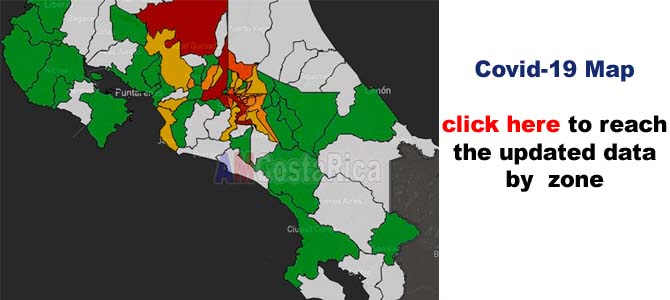 According to the Center for Systems Science and Engineering, CSSE, at Johns Hopkins University, the pandemic has killed 1,232,516 people worldwide. ------------------------------ What else could this study investigate for evidence that staying home and maintaining social distance work as a measure to avoid covid-19 contagion? We would like to know your thoughts on this story. Send your comments to news@amcostarica.com |
||
         
 |

|
|

 |
 |
 |
 |
 |
 |
 |
 |
 |