|
Sea Shepherd asks for donations to help fishermen
By the A.M. Costa Rica staff
The organization, Sea Shepherd of Costa Rica is developing a campaign to provide aid to artisanal fishers who cannot work due to the ban imposed by the Fishing Institute.
According to Sea Shepherd, "artisanal fishermen at this time are even more vulnerable since they do not have fish to take their homes to eat. We want to bring aid to Costa de Pájaros this weekend, but we have not yet gathered the ton of food that we have set as our goal. "
According to the organization, there are more than 100 families that do not have food due to the three-month ban on fishing.
If you want to help those families, donations are being received at the offices of the Sea Shepard organization that are located in Sabana Sur, in San Jose, on 40th Street. More information on this campaign can be found by calling 506-2291-4091.
According to the Fishing Institute, 1,192 fishermen are banned from fishing during August, September, and October.
Due to this prohibition, the government has given them a subsidy of approximately $250 per month, so they can cover the expenses of their homes.
However, the Institute confirmed that there are still approximately 188 fishermen that did not meet all the requirements to receive the subsidy.
The other fishermen who have been able to receive economic support must fulfill 30 hours of communal work as a requirement to earn money.
Related to Captain Paul Watson, founder of the Sea Shepherd, as A.M. Costa Rica reported on March, the Criminal Appeals Court of the Second Judicial Circuit of San José, ruled in favor of Captain Watson, dropping all charges against him and giving closure to a 17-year legal dispute and 13-year-old international arrest warrant.
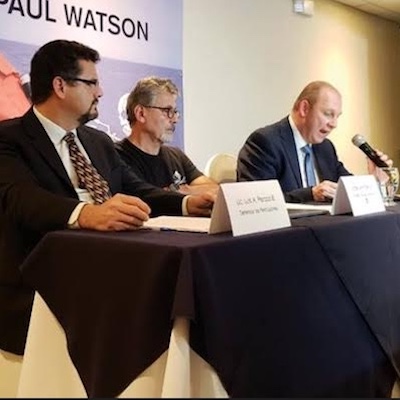
“Thanks to the determination and insistence of our legal defense team, this difficulty is now in the past. I want to thank the people of Costa Rica for their solidarity, the equanimity of their current government, and especially the understanding and support of the Minister of the Environment, Carlos Manuel Rodríguez Echandi", said Captain Paul Watson in its statement. "Now it is time to look ahead and resume the conservation efforts that our organization and thousands of people make every day around the world to defend the environment.”
Related to the future relations between of the organization and Costa Rican government, Captain Watson said, “During all of these years, my sincere desire has always been to protect, together with Costa Rican people, the beautiful natural sanctuary that is the Isla del Coco, and other endangered areas linked to the Marine Corridor of the Eastern Tropical Pacific like the Golfo Dulce and the Osa Peninsula. I hope that now, with this dismissal of these charges against me, we can make it a reality.”
The legal dispute began on April 20, 2002, when the vessel Ocean Warrior, under the command of Captain Watson, was heading to Costa Rica at the invitation of their government. Sea Shepherd had been invited to sign a collaboration agreement for the protection of the world-renowned marine sanctuary, Cocos Island.
The year prior, Sea Shepherd provided the Cocos Island National Park Rangers with equipment and a ship to arrest and confiscate an Ecuadorian-flagged vessel, the San José, for illegally fishing in the protected area of the island.
In 2002, the Ocean Warrior ran into the Costa Rican vessel Varadero-1, whose crew, they discovered, were illegally finning sharks in Guatemalan territorial waters.
According to the Sea Shepherd organization “After the Varadero-1 ignored several requests to cease the continuation of this practice, Captain Watson received authorization from the Guatemalan naval authorities to escort the vessel to the nearest port for arrest. Following this incident, the crew of the Varadero-1 filed several baseless accusations against Captain Watson.”
This situation created a battle in Costa Rica for the legal action taken against the environmental activists.
The entire incident was filmed and featured in the film Sharkwater by late Canadian director Rob Stewart.
“Throughout this legal dispute, Sea Shepherd remained committed to the protection of the marine species in the Cocos Island marine reserve and the Osa Peninsula, especially the various shark species that are most vulnerable to illegal fishing and finning,” said the organization in its press release.
------------------------
Do you know other campaigns raising funds to support people in your community? We
would like to know your thoughts
on this story. Send your
comments to news@amcostarica.com
|
|