|
|

Published
Monday, August 31, 2020
Production of covid-19 treatment made
in Costa Rica possibly increased
to 25,000 units
By the
A.M. Costa Rica staff
On Friday, the $500,000 donation agreement was
signed from the Central American Bank for Economic
Integration, CABEI, to the Clodomiro Picado
Research Institute of the UCR, which could
increase the production of treatment against
covid-19 from 600 to 25,000 units in short time.
CABEI headquarters in Tegucigalpa, Honduras, has
regional branches in six Central American
countries: Guatemala, Honduras, El Salvador,
Nicaragua, Costa Rica and Panama.
With the signing of the contract, between Mauricio
Chacón, representative of the bank and Isabel
Martínez, representative of the Foundation of the
University of Costa Rica, the delivery of the
donation that will help advance the production of
a therapeutic formulation of antibodies against
SARS-CoV-2 is consolidated.
"This economic injection means a great
contribution both for the institute's researchers
in the continuity of their work and for the Costa
Rican community in the search for solutions for
public health in the face of the covid-19
pandemic," the Foundation said in its
statement.
According to President Carlos Alvarado, in
addition to this donation, the government is in
the process of establishing an additional budget
through the Ministry of Science, Technology and
Telecommunications. "We want to go from having six
horses to 30, and going from a production of 600
units to about 25,000," Alvarado said.
On Aug. 13, the bank approved a donation to the
institute to increase the production of the
treatment based on antibodies against covid-19.
According to CABEI, the donation is part of a
$2,500,000 fund distributed equitably among it’s
immediate partner countries: Guatemala, El
Salvador, Honduras, Nicaragua and Costa Rica. The
money is to help aid each country in facing the
emergency caused by the pandemic.
"Since the beginning of the health crisis in the
region, CABEI has focused on assisting in
different ways through the implementation of the
Emergency Support and Preparedness Program for
Covid-19 and the Economic Reactivation program,"
said Dante Mossi, Executive President of CABEI.
"We are pleased to know that Costa Rica will use
this new cooperation in clinical research that
will allow it to fight covid-19."
This donation was made after the Costa Rican
government began to seek funds to strengthen their
treatment production, the institute said in its
statement.
According to Alberto Alape-Girón, Ph.D., ICP-UCR
researcher, the donation will produce the amount
of medicine that the country needs and,
eventually, supply other countries in Central
America.
On Aug. 10, the first batch of 80 units of
covid-19 treatment made by Costa Rican scientists
was delivered to Social Security.
The medicine made with equine immunoglobulins
could constitute an eventual treatment for
patients with covid-19, announced the Social
Security.
The next step is to carry out the clinical
research phase that will be developed in the
Specialized Center for the Care of Covid-19
Patients, known as the Covid Hospital, at the San
Juan de Dios, Mexico and Rafael Ángel Calderón
Guardia hospitals, announced Román Macaya-Hayes,
president of Social Security.
The goal is to give the patients a very strict
follow-up that guarantees the evolution of the
disease to try to confirm, with reliable
statistical numbers, if the treatment developed by
the scientists makes a favorable difference in the
evolution of the disease.
In July, specialists from George Mason University,
in Virginia, U.S.A., confirmed that the treatment
developed by Costa Rican scientists is capable of
inhibiting the infectivity of the SARS-Cov2
coronavirus, which produces the covid-19.
Costa Rican scientists sent samples of the
treatment to George Mason to obtain an alternative
result of the effectiveness of the treatment
against covid-19 in cells.
George Mason University is considered one of the
best biosafety laboratories in the U.S. for
testing live viruses in an environment with all
the conditions of isolation and biosecurity. The
university lab is currently demonstrating that
this plasma neutralizes SARS-CoV-2 and that it is
100 times more powerful than convalescent plasma
obtained from humans, the university said in its
statement.
"The results clearly demonstrate that the horses
produced a large number of antibodies that block
the entry of the virus into human cells," Girón
said. "This indicates that the drug can be very
efficient and that the amount that will be
required to treat patients would be relatively
low.”
According to Carlos Araya, Director of the Costa
Rican University, the treatment developed at the
institute is applied to people infected with
covid-19 preventing them from getting worse.
Given the successful results in the analysis, both
in Costa Rica and in the U.S., the human portion
of the testing is meant to test its effectiveness.
The goal is that the results match those expected
by scientists. If successful, specialists hope to
treat all hospitalized and infected patients sick
with the virus in the country.
Time runs as health authorities continue to find a
cure for covid-19 while cases and deaths increase
due to the virus.
As of Saturday
afternoon, the Ministry of Health provided
the following statistics on the status of the
virus in the country:
• 1,214 new covid-19 cases, bringing the
total to 23,544 active cases. The ages of patients
infected range from a three-month-old baby to a
99-year-old person.
• 9,249 foreign-born have been infected of
the 39,699 cases since March, approximately 23.8%
of the total cases.
• 413 patients are being treated in public
hospitals, where 133 patients are in Intensive
Care Units in delicate health conditions,
280 patients are in recovery rooms. Most of the
infected patients are quarantined in their homes.
• 15,737 coronavirus patients have fully
recovered, which is a 39.6% recovery rate.
• 92,046 people have been ruled out.
• 146,047 medical covid-19 tests have been made.
• 418 deaths of people infected with
covid-19 since March, approximately 1.1% death
rate. Of these 160 were women and 258 men.
The ages range from 21 to a 100-year-old person.
Since July 30, the ministry announced they will
not provide updated information on immigrants who
die from covid-19 in the country. Up to then,
authorities reported 30 foreign-born people had
died from that virus since March.
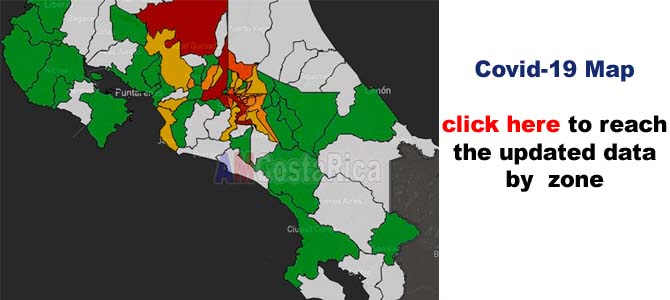
Readers can see the updated number of total
patients in each district at the National Distance
Education University on its Covid-19 Map.
As of Sunday night, the pandemic has killed
845,054 patients worldwide, according to
recent statistics reported by the Center for
Systems Science and Engineering (CSSE) at Johns
Hopkins University.
----------------------------
Should Social Security speed up the application of
the treatment to covid-19 patients? We would
like to know your thoughts on this story. Send
your comments to news@amcostarica.com
|