
 |
   Experts also expect the cost of the vaccine to increase after the pandemic. - A.M. Costa Rica illustrative photo - |
|||
  

    |
Published Tuesday, December 1, 2020 Covid-19 vaccine could cost
less than $37, says report By the A.M. Costa Rica staff and wire services The covid-19 vaccine may be approved for use by the end of December, according to a report from the Healthline Journal on Monday. AstraZeneca announced on Nov. 23 that its covid-19 vaccine is 70 percent effective, making it the third vaccine shown to be effective at preventing a severe case of covid-19. Pfizer and Moderna recently announced their vaccines were nearly 95 percent effective. The U.S. Food and Drug Administration, FDA, will now evaluate clinical trial data, and if all goes to plan, grant emergency use authorization, EUA, in mid-December. According to the report, in the case of the U.S., if vaccines are approved, doses will be shipped and distributed within 24 hours. Top U.S. health officials expect high-priority groups - such as older adults most at risk and frontline workers - to be vaccinated by the time the holidays roll around. Developing and manufacturing the vaccines CAME with a hefty price tag. The cost for each dose ranges from $3 to $37, depending on the vaccine, said the report. Moderna, who has a two-dose vaccine, recently announced each dose will go for between $32 to $37. The Pfizer vaccine, also given in two doses, is expected to cost $19.50 a dose. Each dose for Johnson & Johnson’s two-dose vaccine will cost an estimated $10, and AstraZeneca’s two-dose vaccine could be the cheapest at just $3 to $4 a dose. Novavax’s two-dose vaccine is estimated to be $16 a dose. In the U.S., no individuals, regardless of insurance coverage, will pay out of pocket for the vaccine itself, federal health officials have said. “Vaccine doses purchased with U.S. taxpayer dollars will be given to the American people at no cost,” the Centers for Disease Control and Prevention, CDC, Trusted Source states. Certain vaccine providers may charge an administration fee for giving the shot, but individuals can have that fee reimbursed. “Vaccine providers can get this fee reimbursed by the patient’s public or private insurance company or, for uninsured patients, by the Health Resources and Services Administration’s Provider Relief Fund,” the CDC said. According to the report, there are several other costs to the vaccine that remain unclear. There are also storage costs, as some of the vaccines need to be kept in ultra-cold temperatures that many hospitals and retail pharmacies don’t have on-site. Experts also expect the cost of the vaccine to increase after the pandemic. "The post-pandemic vaccination costs will largely depend on demand. More research is needed to determine if people will need booster shots over the year to maintain immunity, or if the vaccine will need to be given annually like the flu shot," said the report. In Costa Rica, the National Emergency Commission announced on Nov. 24, that it has already begun to buy the necessary supplies for an expected vaccination campaign against covid-19 in 2021. The commission said that purchases so far include large quantities of cotton, needles, syringes, bags, disposable masks, and ultra-low temperature freezers to store vaccines safely. Authorities also began the designing and construction of an exclusive area to store the supplies in Social Security supply warehouses. Among the most important items are 14 ultra-low temperature freezers to store the vaccines scheduled to arrive before March 2021. Of those, 13 freezers can hold 550 liters alongside another with a capacity of 750 liters to store the vaccine for a longer time. The purchases are financed with emergency funds, following the Presidential Decree of National Health Emergency due to the pandemic. In November, the Costa Rican government signed an agreement with the British-Swedish multinational pharmaceutical and biopharmaceutical company AstraZeneca to buy one million doses of its vaccine, AZD1222, which is being developed together with the University of Oxford in England. According to the government, each dose will be priced at $4, so the estimated price of this purchase is at least $4 million, without including additional distribution costs. Vaccine purchases would be made with funds from the National Emergency Fund that is being used to face the crisis caused by the pandemic. The vaccine would be administered in two sessions, meaning that one million doses would cover half a million people. It is estimated that the vaccine will be made available in the first quarter of 2021, as long as the ongoing clinical trials are successful and it is approved by international regulatory organizations. In October, authorities at the Ministry of Health announced an agreement with Pfizer and BioNTech for the purchase of 3 million doses of the BNT162b2 vaccine. The cost of the purchases has not been disclosed due to a commercial confidentiality agreement required by the companies, the government said. The National Emergency Fund is paying for the vaccines and expects to receive the treatment gradually in the first quarter of 2021. The government joined the COVAX-Facility program coordinated by the World Health Organization. In the case of COVAX agreement, the first advance payment of $6,316,560, or 30% of the cost, was scheduled to be made in October, the government said in its statement. The payment is based on the $10.55 price tag set by COVAX. The price includes factory costs, access, financing, risk mitigation and operating costs. Time is running for scientists in the race to find a cure for covid-19, which continues causing mass global deaths. On Monday, the Health Ministry announced the most up-to-date statistics on the evolution of the virus in the country: • 539 new covid-19 cases, bringing the total to 50,386 active cases. • 19,806 foreign-born people have been infected with a total of 139,638 cases since March, approximately 14% of the total cases. Of these, authorities confirmed the death of 32 foreign-born patients. But since October, there is no updated information about foreign-born deaths due to covid-19. • 534 patients are being treated in public hospitals, where 211 patients are in ICU’s in delicate health conditions (ages range from 1 to 89-year-old). And 323 patients are in recovery rooms. Many of the remaining infected patients are quarantined in their homes. • 87,526 coronavirus patients have fully recovered, which is a 62.7% recovery rate of the total cases since March. • 397,311 medical covid-19 tests have been performed in Costa Rica since March, this according to the Center for Systems Science and Engineering of Johns Hopkins University, • 1,726 deaths of people infected with covid-19, approximately 1.2% death rate of the total cases since March. Of these 651 women and 1,075 men. The ages range from a 9-year-old to a 101-year-old person. Readers can see the updated number of total patients in each district at the National Distance Education University on its Covid-19 Map. 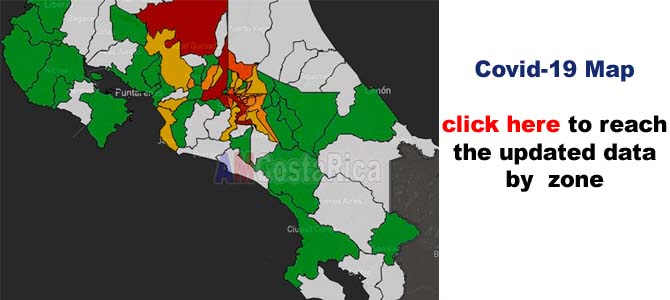 According to the Center for Systems Science and Engineering, CSSE, at Johns Hopkins University, the pandemic has killed 1,476,870 people worldwide. -------------------------- Should health authorities increase the number of covid-19 diagnostics tests being performed? We would like to know your thoughts on this story. Send your comments to news@amcostarica.com
|
||
|
Expats
businesses are crucial to our community
Support professional's services and business  |
|
Nonprofit organizations  Relocation & Tours
Education
Consultation Services
 |
|||
|
U.S.
Income Tax & Accounting
 |
|||
Fine Art restoration
 Real
Estate Agents
   |
|||
|
TimeShare
Services
 Shipping
Services
 Laboratory
and Medical Services
 Business
Consulting Services
    |
|||


 |
 |
 |
 |
 |
 |
 |
 |
 |