Well, the rainy season is over and here comes the sun. For us at the lake, the sun also means we are going to have some of our fiercest winds. A beach-loving friend tells me that going to an unsheltered spot on the beach is like walking into a sandblaster - sort of a free leg hair removal system.
Up here, we have about finished planting our new trees and making sure they are secured against the wind. That means staking, tying down, and even caging things with wire.
There are hazards in the windy season. Dead branches are falling. Even in the forest, trees whose roots were loosened by rain are now being buffeted this way and that. Falling branches and trees can be hazardous to your health.
There is another problem worth mentioning and has to do with bromeliads. I am very fond of bromeliads, especially the little ones with red leaves that brighten up bare branches. The large ones, however, can weigh 3 kilos or more. With those leaves open to the sky, they can catch an hold a lot of rain water, water that weighs a kilo or so per liter.
The water collection properties of bromeliads are a huge bonanza for a lot of tropical animals. Frogs lay their eggs in the tiny pools and revisit them to feed their tadpoles. If a monkey needs a quick drink, they don’t have to venture to the ground to get it. A life saver for them as the forest floor can be dangerous. Birds also take advantage of dinking from these special pools and can sometimes find a tadpole snack or an insect nearby.
So what does all this have to do with a gardener? Look around your yard and forest edge (if you have some). How many large bromeliads do you have on that branch? Bromeliads, in and of themselves, do not hurt a tree, they are epiphytes not parasites.
|
But their weigh and the weight of the water they carry can be too much for a branch especially in a heavy wind. If a branch is crowded with them, some need to go.
The best tool for this is an extension rod with a hook or a saw. I prefer a hook and I can then relocate the bromeliad to a log on the ground and let it continue to grow. Some of my best bromeliads are growing on branches that I found on the ground. No need to disturb them, just carry the log to a new spot.
So, clean up those excess bromeliads and stay away from falling branches.
Plant for the Week
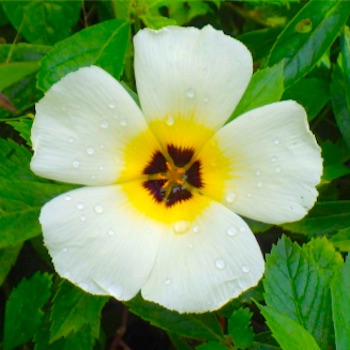
Victoria Torley courtesy photo
The Turnera subulata or white buttercup is a delightful little flower native to Central and South America. Grow it in the sun and enjoy watching the flowers open in the morning and close in the afternoon. Since it is native, the white buttercup is well adapted to our climate extremes but will enjoy occasional fertilizing. A great plant for the garden or hanging baskets.
Editor's note: Victoria Torley, gardener columnist, can be reached at victoriatorley1@gmail.com
*Click on the blue letters to reach the place in google maps.
|