|
|
||||||||||
|
|
|
|
|
|
Food |
|
Cerro de la Muerte area is under maintenance work |
|
 By the A.M. Costa Rica staff
The Ministry of Public Works, through the National Road Council, calls on drivers to take precautionary measures while driving on the Cerro de la Muerte* (“hill of death”) due to maintenance work. Work is being done on National Route #2, the Inter-American South Highway, and between Cartago* and Pérez Zeledón*. The Council states that the work on Cartago roads includes gutter and slope maintenance, sewer changes, tree pruning and deep patching. In the area of La Cangreja National Park*, roadwork includes the maintenance of the walls on the side of the road and the entire area will have demarcation lines repainted and asphalt repaired. According to the Council, these works cost ¢7 million colones ($11,644). The Ministry also reported that workers are repairing concrete in places where ascent rails were built. The cost of these additional repairs was ¢45 million colones ($74,859). During February, the ministry expect to complete the cleanup in different sections of the route, with an investment of ¢25 million colones ($41,588). Specialists recommend that drivers take precautionary measures to avoid accidents while driving in mountains areas, as follow: - Make sure that your brakes, windshield wipers, heater, and exhaust systems are in good condition. Ensure that your brake and transmission fluids are filled and have been changed within the interval recommended for your vehicle. Brake fluid, as it ages, takes on moisture and contaminants that lowers its boiling level. Frequent brake use can overheat the fluid and you can lose braking efficiency when it is most needed. Also check the tread on your tires and ensure that they are properly inflated. - Don't go down a mountain road any faster than you can go up it. Don't use your brakes to hold your downhill speed. Down shift to S or L - the only time you should step on your brake pedal is to slow while you are shifting down to a lower gear. Resist the temptation of zooming down a hill. - On steep upgrades, downshift to a lower gear, watch the temperature gauge in your vehicle, and turn off the air-conditioning if it starts to overheat. If you need to cool the engine, find a safe place to pull off the road, park it and keep the car at a fast idle. Do not shut off the engine, and never remove a hot radiator cap. A faster way to cool an engine is to turn on the heater, but usually that option is a bit unpleasant for the driver. - Don't "hug" the center line. Most mountain roads are narrow and some drivers have a tendency to hug the center line, but this driving technique is both unwise and irritating to other drivers. If you are hugging the center line, and another center-hugging vehicle comes around a curve from the opposite direction, both drivers may over correct and create a hazardous situation. |
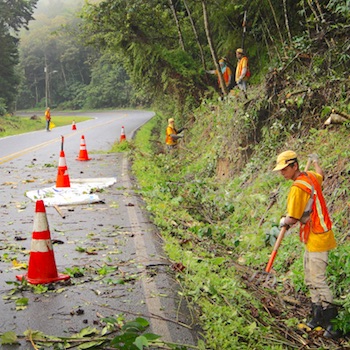 National Road Council courtesy photo Work on
roads includes gutter and slope maintenance,
sewer changes, tree pruning and deep patching.
- Always remember that the car going uphill should be given the right of way. Always allow plenty of time for passing vehicles to make it back to their lane. Keep in mind that higher elevations diminish a vehicle's available horsepower. - Slowing down for any reason, whether it's to view scenery or because of a steep grade, is acceptable road behavior, as long as you maintain awareness. If traffic behind you grows to more than three vehicles, look for a designated pullout and let the traffic pass. - If you choose to explore unpaved side roads, follow these three rules. First, check local weather and road conditions that may affect your drive. Second, unpaved surfaces provide significantly less traction, so slow down and take curves on a wider arc than you might attempt on paved roads. Third, let someone know where you are going and when you expect to return. - Always carry extra drinking water, and remember to drink fluids throughout the day. At higher elevations, insufficient hydration can lead to the onset of symptoms of altitude sickness. Even if they're mild, they can affect your alertness. - In the event that weather conditions deteriorate into rain, slow down, be more observant, and demonstrate extra road courtesy. If other drivers appear to be in a hurry, let them pass - it may be an emergency. It is also important to keep the gas tank filled. Another courtesy to remember when in conditions of reduced visibility or at night is to dim your high beams as soon as you see the sweep of an oncoming vehicle's lights. Hampering the other driver's night vision is more dangerous when there's a cliff involved. - Take frequent breaks. Because navigating mountain roads can be more tiring than flatland driving, consider limiting travel on challenging roads to no more than three hours per day. ----
Are there roads that needs repair where you live? We would like to know your thoughts on this story. Send your comments to: news@amcostarica.com *Reach the place on google maps. |
U.S. Tax
International
Plus Costa Rican taxes, accounting, and legal services. Over 16 years in Costa Rica  Contact Us: U.S +786-206-9473 CR +506-2290-3060 or +506-6242-9879 E-mail: accounting1@ustaxinternational.com Web page: www.ustaxinternational.com Code:9398-xxx
|
|
|||||||||||||||||||