|
 |
Your daily |
 |
|
|
|
|
|
|
|
|
|
|
|
|
|||||||||||||||
|
|
|||||||||||||||
 |
 |
| A.M. Costa Rica Second newspage |
|||||||||
| Home |
Tourism |
Calendar |
Classifieds |
Entertainment |
Real
estate |
Rentals |
Sports |
About us |
|
|
|
|||||||||
 |
| Costa Rica Expertise Ltd http://crexpertise.com E-mail info@crexpertise.com Tel:506-256-8585 Fax:506-256-7575 |
 |
|
to advance trade measure By the A.M. Costa Rica staff
Rodrigo Arias Sánchez, the minister of the Presidencia, made a hurried trip to the legislature Tuesday to stitch together the fraying government coalition there. The result was that 38 legislative deputies, a two-thirds majority, voted to put a bill about amendments to the free trade treaty on the fast track. The government representatives failed to get the same agreement on a measure relating to intellectual property. That bill still is in the air. Both bills are key to the implementation of the free trade treaty with the United States. Bienvenido Venegas, a Partido Unidad Cristiana deputy, played the legislative equivalent of let's make a deal before he pledged his vote on the amendment measure. He got a promise from Arias and other government representatives to invest some $7 million in water lines and roads in the Provincia de Puntarenas that he represents. He also won agreement that the government would back and push changes in legislation for the Instituto Nacional de Pesca y Acuicultura, the agency that controls fishing. The government also agreed to asphalt the route to Monteverde between Guacimal and Los Ángeles and to improve the gravel roads in the central canton of Puntarenas. He also got a promise to improve the national routes of Puntarenas, Esparza, Montes de Oro, Aguirre and Parrita, including the systems of drainage and treatment for dust. In addition, the government agreed to approach the World Bank for money to finance a port city project for Puntarenas the same way it is developing Limón. The government has been making a number of promises to lawmakers in order to keep the coalition alive to pass all the related free trade measures. What is new here is that the deal was reported officially by the legislature. The vote means that a firm deadline was fixed for studying the amendment issue in committee and that when it reaches the floor of the full legislature lawmakers will have limited time to discuss it, just 22 consecutive sessions. Usually lawmakers can discuss a measure all they want, raising the possibility of filibuster by opponents. There were 12 votes against the fast track proposal from members of the Partido Acción Ciudadana, José Merino del Río of Frente Amplio and Oscar López of Accesibilidad Sin Exclusión. They have voted against nearly all free trade measures. Lawmakers have a September deadline to pass all the measures related to the free trade treaty for it to go into effect. Big drug case decision scheduled for this Friday By the A.M. Costa Rica staff
Two lawyers accused of international drug trafficking will learn their fate Friday, said a court spokeswoman. The lawyers, who have the last names of Venegas and Arce are accused of smuggling cocaine through Costa Rica to the north. The prosecutor in the case says Venegas and Arce were part of a band of seven men who attempted to smuggle 1,829 kilograms of cocaine in 2004. The other five men also will be learning the court's decsision Friday, said the court spokeswoman. The Fiscalía Adjunta de Narcotráfico asked the court for a 24-year sentence for Venegas and a 12-year sentence for Arce. The verdict will be read at Tribunales de Justicia de San José at 2:30 p.m., said the spokeswoman. The original decision was scheduled for Monday, but was postponed due to complications, said the court spokeswoman. Three other men implicated in the case have the last names of Méndez, Paniagua, Porras. The prosecutor asked for 20, 17, and 10 years of prison time for each man respectively. The prosecutor asked the judge for 15 years each against two men with the last names of Gamboa and Barboza. Two new ambassadors present their credentials By the A.M. Costa Rica staff
New ambassadors from Guatemala and Egypt presented their credentials Tuesday at Casa Presidencial. Sitting in for the ailing Óscar Arias Sánchez was Laura Chinchilla, the country's vice president. Carlos Ramiro Santiago Morales is the new ambassador from Guatemala. Reda Halim Fahmy Ibrahim is the Egyptian ambassador. Santiago Morales was a commercial attaché here in 1991 and second secretary at his embassy from 1992 to 1998. The new Egyptian ambassador has served in Colombia, Burkina Faso, Gaza, Albania, France and Kuwait.
|
 |
 |
 |
| A.M. Costa Rica third newspage |
|||||||||
| Home |
Tourism |
Calendar |
Classifieds |
Entertainment |
Real
estate |
Rentals |
Sports |
About us |
|
|
|
|||||||||
 |
 |
 |
| Earthquakes
downed one house and damaged 22 more |
|
|
By the A.M. Costa Rica staff
Earthquakes destroyed one house and damaged 22 more in the southern zone, said the national emergency commission after a complete assessment Tuesday. Most of the damage was reported in Pueblo de Dios a small town in the south, said a spokeswoman from the Comisión Nacional de Prevención de Riesgos y Atención de Emergencias. Part of the road between Santa Rosa and Caracol collapsed, and officials at two schools said their walls had cracked from the earthquake, said the spokeswoman. The hospital in Ciudad Neily also reported cracking in several walls, after attendants evacuated part of their |
building
Monday, said the
spokeswoman. The damage is minor however, and the hospital will
continue to operate with complete normality, she added. The commission
said it provided shelter for 18 people in Pueblo de Dios and Santa Rosa. Experts from the University of Costa Rica said the possible cause of the earthquake is a system of active faults on the edge of the Coco and Nazca tectonic plates, said the spokeswoman. According to the Red Sismológica Nacional de la Universidad de Costa Rica, Monday's strongest tremor registered at 5.6 on the Richter scale and was located 37 kilometers (23 miles) south of the community of Laurel, she added. |
| Tamarindo
plans another cleanup to keep dengue at bay |
|
|
By Helen Thompson
of the A.M. Costa Rica staff With the first rains of the season, Tamarindo's community is losing no time in taking action against the possible spread of dengue fever. Rubbish collections and clean-ups in public places are the first priority for Tamarindo's Asociación Pro Mejoras de Playa Tamarindo, with a volunteer-driven initiative in the town's Independence Park planned for Saturday. The Aedes aegyptus mosquito which carries the disease breeds in clean stagnant water, which can accumulate around blocked drains or in discarded containers. Insects are distinctively striped black and white. Sufferers of the disease may show symptoms including a high fever, headache, joint pain, sickness, eye pain and a rash. It is also possible to contract a more severe form called dengue |
hemorrhagic fever
when these signs last for up to a week and are followed by signs of
hemorrhages, such as bruising, nose bleeds, bleeding gums and possible
internal bleeding. This can lead to shock and is the most common form
of death among dengue sufferers. So far 2,324 cases of dengue fever have been reported in Costa Rica this year. To prevent mosquitoes breeding in the house, residents should take special care with potted plants, not allowing water to accumulate in plates or trays, and turning watering cans upside-down, officials say, adding: Drains and gulleys should never be blocked. Sand granulated insect preventatives can also be added to vases and roof gutters. The clean-up in independence park started two weeks ago, and already 30 bags of garbage have been removed from the site. Volunteers are needed to continue working on the area every Saturday from 7 a.m. to 11 a.m. |
| Five
fishermen who lost their boat pulled from sea safely |
|
|
By the A.M. Costa Rica staff
Coast guard officers rescued five fishermen near the Isla de Coco Tuesday, said a security spokesman. The men, three Nicaraguans and two Costa Ricans, were fishing in a permitted area off the island, when their boat began to sink, said the security spokesman. The last words the men radioed were “We're sinking! We're sinking,” said the security spokesman. The men were then forced to abandon ship, then they stayed adrift for two hours, said the spokesman. |
Costa Rican coast guard officers on
the private ship MarViva found the
men 40 miles (35 kilometers) off the shores of Isla de Coco, said the
spokesman. The men were identified by the security ministry as Manuel Lopez Alvarado, Pastor Anastasio Lopez, Roberto Carlos Marchena, Cesar Rivas Rosales and Tomas Garcia Castro, the captain. The coast guard brought them to Isla de Coco, where Cruz Roja workers waited to assist them, said the spokesman. All of the men were found to be in stable condition, he added. |
| You need to see Costa Rican tourism information HERE! |
 |
| A.M. Costa Rica fourth news page |
|||||||||
| Home |
Tourism |
Calendar |
Classifieds |
Entertainment |
Real
estate |
Rentals |
Sports |
About us |
|
|
|
|||||||||
|
Health officials wrestle with
ending wave of cervical cancer
|
|
|
Special to A.M. Costas Rica
Some 33,000 women in Latin America and the Caribbean die each year of preventable cervical cancer, caused by a virus that infects 20 percent of men and women in the region and as many as 30 percent of the youngest women, according to a new study. Dramatic new opportunities offered by better screening, treatment and the securing of an affordable vaccine for girls and young women could reduce the current death toll and prevent it from rising to 70,000 over the next two decades, say researchers who analyzed the regional impact of the human papilloma virus. The findings come form a Mexico City conference to discuss cervical cancer control in Latin America and the Caribbean, convened by the World Health Organization, Pan American Health Organization, the Albert B. Sabin Vaccine Institute, and the U.S. Centers for Disease Control and Prevention. The new analysis of 15 years of research on the human papilloma virus in Latin America and the Caribbean provides the first comprehensive assessment in the region, suggesting the virus is far more common than expected and that in the absence of intensive intervention the region will see a substantial increase in deaths from cervical cancer, said Ciro de Quadros, executive vice president of the Albert B. Sabin Vaccine Institute, which commissioned the study in collaboration with the other health agencies. The two-day meeting focused on the urgent need for new approaches to screening and treatment, in addition to preventive vaccines, to avoid what could be a substantial increase in cervical cancer deaths in the coming decades. According to experts at the meeting, if precancerous lesions caused by the human papilloma virus are left undetected and untreated, an estimated 70,000 of today's young girls in Latin America and the Caribbean will die in the prime of their adulthood by 2030, deeply affecting their families and communities. The study also explores the economics of adopting a human papilloma virus vaccine that is currently the most expensive childhood immunization in the world. It concludes that over a 10-year period the vaccine has the potential to prevent more than half a million deaths in the region, but it may have significant financial implications for the health care systems of the countries studied. |
The analysis indicates that the
prevalence of human papilloma virus
among Latin American and Caribbean women 15-24 years old is 20 to 30
percent, and 20 percent among men in the region. The work is based on a review of 15 years of studies from Argentina, Barbados, Bolivia, Brazil, Chile, Colombia, Costa Rica, Cuba, Ecuador, Honduras, Jamaica, Mexico, Nicaragua, Panama, Paraguay, Peru, Surinam and Venezuela, said co-author Maria Teresa Valenzuela, professor of epidemiology at the University of the Andes in Chile. The study also highlights the inequities in access to the health services that can prevent HPV from progressing to cervical cancer, Professor Valenzuela noted. For example, it estimates that of the 86,000 women in the Americas who are diagnosed each year with HPV-related cervical cancer, some 72,000 live in Latin America and the Caribbean, which also accounts for almost all of the annual cervical cancer deaths in the Americas, in a 2003 study. For example, Mexican researchers found that in Mexico, between 1990 and 2000, on average one woman died every two hours from cervical cancer. The two vaccines currently available are virtually 100 percent effective at preventing infections from the two strains of the virus responsible for the majority of cervical cancers. Though, they are not "therapeutic vaccines" in that they cannot be used to treat pre-existing infections, and thus are not a substitute for strengthening screening and treatment. However, cost is a key factor in bringing immunizations to countries in Latin America, the Caribbean and elsewhere in the developing world given financial constraints on national health care spending. For example, the study found that the price of the vaccine now used in the U.S. —which sells for $360 for the required three-dose regimen — would need to come down considerably to become affordable in the region. At its current price of $360, the cost of vaccination over just five years (for five separate birth groups of 12-year-olds) would be $4.7 billion for six countries studied. If the price came down to $50, it would be $621 million for the five-year period and at $25 it would be $290 million. |
|
New Jason 2 satellite will
keep an eye on rising ocean levels
|
|
|
Special to A.M. Costa Rica
A satellite that will help scientists better monitor and understand rises in global sea level, study ocean circulation and its links to climate and improve weather and climate forecasts will launch June 15 from Vandenberg Air Force Base in California. The Ocean Surface Topography Mission, also called Jason 2, is a joint effort of the national Aeronautics and Space Administration, the National Oceanic and Atmospheric Administration, the French space agency Centre National d'Etudes Spatiales and the European Organisation for the Exploitation of Meteorological Satellites. The mission will extend into the next decade the continuous recording of sea-surface height measurements begun in 1992 by the NASA-French space agency TOPEX/Poseidon mission and extended by the NASA-French space agency Jason 1 mission in 2001. The satellite will continue monitoring trends in sea-level rise, one of the most important consequences and indicators of global climate change. TOPEX/Poseidon and Jason 1 |
measurements
show that mean sea level has risen by about 3 millimeters ( about a
tenth of an inch) a year since 1993, twice the rate estimated from tide
gauges in the past century. But 15 years of data are not enough to
determine long-term trends. High-precision ocean altimetry, developed through NASA and the French space agency, measures the height of the sea surface relative to Earth's center to within about 3.3 centimeters. These measurements, called ocean-surface topography, give scientists information about ocean current speed and direction. Because the amount of heat in the ocean strongly influences sea-surface height, height also can indicate where ocean heat is stored. Combining ocean current and heat storage data is key to understanding global climate variation. Since the last ice age ocean levels have risen about 200 feet. This is a problem for archaeologists who try to locate long-ago camp sites. As the sea level rose, it covered most of the early coastal settlements. The sea is expected to rise about two feet by the end of this century, according to some estimates. |
 |
|
| News from
the BBC up to the minute |
BBC sports news up to the minute |
| BBC news and sports feeds are disabled on archived pages. |
|
| A.M. Costa Rica fifth news page |
Are
you
still
spending 70 percent You need to fill this space ASAP! |
||||||||
| Home |
Tourism |
Calendar |
Classifieds |
Entertainment |
Real
estate |
Rentals |
Sports |
About us |
|
|
|
|||||||||
 |
 |
|
Brazilian aircraft
maker betting on U.S. and Florida By the A.M. Costa Rica wire services
The Brazilian aircraft manufacturer Embraer is set to build a factory in the southern U.S. state of Florida to make executive jets. The move by the world's fourth-largest aircraft manufacturer comes as the U.S. economy is in a downturn and continues to lose manufacturing jobs. However, Embraer executives say they have confidence in the future of the US economy and its aviation industry. Workers at Embraer's main manufacturing plant — about two hours outside of the southern Brazilian city of Sao Paolo — build planes for airlines including US Airways, Northwest, and Jet Blue. Embraer is the world leader in sales of small commercial jets of up to 120 seats. At a gathering in Florida recently, Florida Gov. Charlie Crist announced Embraer will now invest an estimated $50 million, building its first factory in the United States. "They've got courage. You know, in order to be a leader you've got to have courage," Crist said. Courage may explain Embraer's decision to open a U.S. plant at a moment when the American economy faces tough times with millions of manufacturing jobs lost since 2000 - 46,000 in April alone. Embraer's President and CEO Frederico Curado says he views the investment as a bet on America's future, "We do not see the current crisis in the United States as a long term one," he said. "We do believe in the recovery of the U.S. economy. I see many companies leaving the U.S. We just think the opposite — we think this is the right moment to invest in the U.S. and be ready when the crisis is over." Embraer, which will reportedly get millions of dollars in grants and tax breaks to move to Florida, will initially assemble executive jets at its new American plant. The company says 60 percent of its private aircraft sales come from the United States, even as Americans tighten their belts amid rising fuel prices and the sluggish economy. U.S. aircraft makers report growing demand abroad — in countries such as China and India. Overseas orders for General Dynamics' Gulfstream jets surpassed sales in North America for the first time last year. But Curado anticipates continued strong demand for his company's jets within the U.S. market. "We have our largest consumer market here and we also have our largest supplier base in the United States. So it's a natural step for us to come closer to our customers," he said. The new 14,000 square-meter plant will employ workers in fields ranging from flight testing to aircraft-interior design. But despite the fanfare, the boost to the U.S. aerospace industry and manufacturing from Embraer's investment could be minimal. The company is expected to create 200 jobs in Florida by 2011 — a fraction of the thousands of aerospace jobs expected to be lost in the state when the U.S. space agency, the National Aeronautics and Space Administration, ends its space shuttle flights in 2010. |
| A.M. Costa Rica Sports news local and from the wires |
 |
|
|
|
|
|
|
|
|
|
|
||||||
|
||||
|
Food, festivals, arts, entertainment, poker |
|
|
|
|
|
|
|
|
|
|
| The advice is to play more hands for smaller tourney pots |
|
|
There
are a couple of methods to amass a big stack in tournament poker.
One way is to try pushing small edges before the flop by playing coin
flip situations, like a pair versus two overcards, or vice versa.
The problem is that this approach is far too inconsistent. You’ll
need lots of luck to get your side of the coin to repeatedly flip in
your favor. A better approach to build a sizable chip stack is to play more hands in smaller pots. This method is based on mathematical theory, not just random luck or pure aggression. Here’s an extreme example to illustrate my point. The blinds are 400 to 800 with a 100 ante. With nine players at the table, 2,100 chips are in the pot before the cards are dealt. Now, let’s assume that you and one other opponent play wildly; one of you will raise to 2,000 before the flop on every single hand. The other players are very tight and will enter the pot about 10 percent of the time. The only time you or the other maniac will fold pre-flop is when one of the tight players also raises before the flop. Furthermore, assume that when only you and the other crazy player are in the pot, neither of you will bet after the flop, turn, or river. Theoretically, each of you should win 50 percent of the pots. However, when any tight player enters the pot, you would each play your normal game, playing hands that have value, and betting as you normally would. This situation isn’t actually that far fetched and commonly plays out in some of the bigger buy-in events on the professional tour. Just watch when Gus Hansen and Phil Ivey are seated at the same table. You’ll notice that most of the hands played are contested between these two poker greats. They won’t necessarily play big pots but they’ll definitely get involved in most of the smaller ones -— unless a tight player shows aggression before the flop. Let’s get back to the example. Say you put in 2,000 chips 10 times during a session, or 20,000 chips in total. Before factoring in the tight players at the table, you’ll win about half of these pots against the other loose player and earn about 20,500 chips. Of course, you’ll |
 lose the other five pots for a total of 10,000 chips but will still net 10,500 in profit overall. That’s not bad but it’s not the whole story, either. Every so often, a tight player will find a hand that he wants to play. He might reraise before the flop causing you to fold, and that’s okay. Hey, you might pick up a premium hand like pocket aces or kings and get some unexpected action from one of the tight players, too! There are two keys to making this strategy work. First, avoid traps being set by tight players. Second, show respect to aggressive players by trying to keep the pots small. Sounds easy, doesn’t it? Well, maybe easy in theory, but it’s a bit tougher when you’re sitting at the table. Playing more hands in smaller pots is how many top professionals consistently build large stacks in tournament poker. They just won’t gamble for large sums before the flop. Instead, they’ll simply enter more pots than the average player, and play more carefully when they do. In tournament poker, don’t be afraid to gamble a little bit. There’s nothing wrong about being an active player. But make certain to maintain discipline and only play bigger pots on your own terms. Visit www.cardsharkmedia.com/book.html for information about Daniel Negreanu’s new book, "Hold’em Wisdom for All Players." © 2008 Card Shark
Media. All rights reserved.
|
| Art Galleries ... |
|
Surreal circus art leaves circle of life question open to onlookers  Wandering around the
Museo Calderon Guardia, looking at austere
historical artifacts about the socialist former president complete with
wax-work statue, the last thing a visitor expects to come across is a
circus tent. Wandering around the
Museo Calderon Guardia, looking at austere
historical artifacts about the socialist former president complete with
wax-work statue, the last thing a visitor expects to come across is a
circus tent. Until May 22, that is precisely what museum-goers can expect when they enter the small temporary exhibition space. A colorful toy snake curls around the bottom of a notice board announcing “Introvoco” with two clown shoes fastened to it. The floor is covered in a carpet of hay, giving the room a barn-yard smell, and most of it is obscured by a blue tarpaulin. Read more - click here |
Art Biennial breaks down national stereotypes  A work of art that
involves only a
metal key is among the most acclaimed piece in the Museo de Arte
Costarricense's latest exhibition. A work of art that
involves only a
metal key is among the most acclaimed piece in the Museo de Arte
Costarricense's latest exhibition.Also on display are old Caterpillar boots, a patchwork quilt and a foosball table, all aimed at breaking down the stereotypes that exist between Costa Ricans and Nicaraguans. As Nicaraguan migration into Costa Rica continues, so do tensions between the two national groups. The U.S. Department of State's most recent estimate was that up to 15 percent of the population of Costa Rica is made up of Nicaraguans who have migrated here mainly in search of work. Read more - click here |
| Dramatic Arts ... |
|
Poets from 15 countries come to San José Latin America is renowned for its literature, and this weekend marks the inauguration of a festival that unites poets from across the region, not to mention from Europe, Africa and the United States. The VII Festival Internacional de Poesía will bring prize-winning writers from all over the world to venues all over Costa Rica, including hospitals and prisons, with the grand opening scheduled for Friday at 7 p.m. It claims to be the second most important poetry festival in the Americas, and is organized by Fundación Casa de Poesía, who said getting visas for all the artists to enter the country proved rather difficult. Read more - click here |
Salsa and big band collide in a night of dinner and dancing Music students of Pérez Zeledón and salsa-dancing fans of the group Son de Tikizia are preparing for a night of dinner and dancing to be held in the capital of the province. The big band of the town that calls itself Pérez Zeledón, but whose actual name is San Isidro del General, will join dancers from the Universidad Nacional to present Cena Bailable May 23. A concert by the 25 members of the big band will start off the evening, which will continue with a buffet-style dinner and end up with dancing. Read more - click here |
| Food... |
|
Café culture uncovered in San José 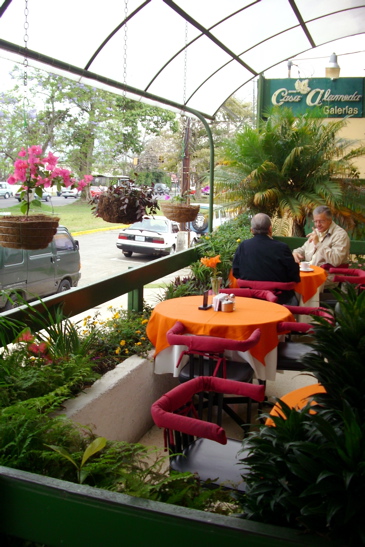 In San José there are plenty of places to catch a coffee. A soda will give you a coffee on the run, but it won't have a nice selection of frapucchinos, and the most European lunch on offer will be the ubiquitous ham and processed cheese sandwich. The plastic atmosphere of the proliferation of coffee shops found in city malls doesn't cut it in comparison with the artsy, individualistic establishments in which musicians, revolutionaries, poets and artists got together next to the river Seine. After one casado too many, there are, however, a few places to go for a brief retreat towards the European ideal. Claudio's Delicafé  Arguably one of San José's most attractive buildings, this café is attached to an art school and is not afraid of letting the creativity filter through into the café itself. Previously known as Café Arte, the French owner of San Pedro restaurant Le Chandelier recently took over the café and has restyled the entire thing, very much to its benefit. One corner of the café is a tower-like extension, its cylindrical shape and many windows giving an airy atmosphere. Wicker-backed chairs, wooden sofas and arty photography give the interior an understated style. Click here for more café reviews |
Mini-mall comes to the rescue of the not-rich-but-hungry  For those in the
know, there is a clean, affordable, relatively quiet
gastronomic surprise off the pedestrian mall in downtown San
Jose. Between Arenas clothing store and the Patio Restaurant,
behind a perfume counter and a Pops Ice Cream sits a food court without
a McDonald's, Wendy's, Subway or Church's Chicken in sight. For those in the
know, there is a clean, affordable, relatively quiet
gastronomic surprise off the pedestrian mall in downtown San
Jose. Between Arenas clothing store and the Patio Restaurant,
behind a perfume counter and a Pops Ice Cream sits a food court without
a McDonald's, Wendy's, Subway or Church's Chicken in sight. Click here to read more Festive season proves troublesome even for established restaurant  Being a chef in a
busy kitchen must be a pretty stressful job, but
around Christmas stress is something any successful restaurant should
factor in as inevitable. Being a chef in a
busy kitchen must be a pretty stressful job, but
around Christmas stress is something any successful restaurant should
factor in as inevitable. On a second visit to well-reputed French restaurant Le Chandelier, it soon became obvious that the staff were poorly equipped for the onslaught of Christmas party diners on a Tuesday night, leaving the usually decent food to deteriorate into a procession of almost inedible starters and bland entrees. Click here to read the full review A great meal is not all in the presentation  With a vaulted
glass ceiling, palm trees lining the pathway and posh lighting, one
would not expect Saga restaurant to be settled behind a dull parking
lot in Escazú. With a vaulted
glass ceiling, palm trees lining the pathway and posh lighting, one
would not expect Saga restaurant to be settled behind a dull parking
lot in Escazú. Although this restaurant may look out of place, it doesn't deviate much from the norm in Escazú, an area many would classify as suburban sprawl. Click here to read the full review |
| Books ... |
|
Heredia author mixes teen romance with leatherback turtles  A 15-year-old girl
who is infatuated with buff surfers and Gucci shoes is setting out to
convince other teenagers her age that caring for leatherback turtles
and saving the environment is just as cool as going to the mall. A 15-year-old girl
who is infatuated with buff surfers and Gucci shoes is setting out to
convince other teenagers her age that caring for leatherback turtles
and saving the environment is just as cool as going to the mall.Penelope, as she is called, is the creation of Heredia resident Marina Kuperman, a New York native who has recently finished the “eco-adventure” novel “Turtle Feet, Surfers Beat.” Written to target girls aged 9-14, the 86-page novel is printed entirely on eco-friendly paper and follows the story of Penelope and her family as they relocate to Tamarindo for a month. Forced to work as a volunteer at the Leatherback Biological Centre, Penelope, who has been recently dumped by her quarterback boyfriend, falls in love almost simultaneously with leatherback turtles and a blonde surfer called Kendall Brown. Click here to read more |
Land use in Costa Rica documented by Fulbright scholar Forty years of living in the jungle, moving between secluded forestry stations and research labs, has led Louisiana resident and NASA veteran Armond Joyce to write a book about the changing uses of land in Costa Rica. After winning a presitgious Fulbright scholarship in 1998, he came back to Costa Rica to revisit forest sites that he worked on over three decades earlier as a graduate student. Click here to read more New book dwells on the social aspects of food Food is not just a selfish pleasure or a way to stifle hunger, but is central to the evolution of art, according to a new book published by Museos del Banco Central. Artworks by Costa Rican painters are the main content of the hardback book, “Imagenes para Comer,” which follows the representation of food in art since still life painting became popular in the Renaissance. Click here to read more |
|
|
|
|
|
|
|
|
| What we published this week: | Monday | Tuesday | Wednesday | Thursday | Friday | Earlier |
|
|